

Technical Plotter Paper Rolls: Guaranteed Accuracy for Engineering Plans (HP, Canon, Epson)
Premium Paper for HP, Canon & Epson Plotters. Optimized performance for technical drawings, architectural designs, and engineering plans. Get help how to order online here.
Available Plotter Paper Rolls
Browse our complete range of technical plotter paper rolls compatible with HP DesignJet, Canon imagePROGRAF, and Epson SureColor printers.
Plotter paper & media
Plain plotting paper, coated, photo and linen rolls for every HP DesignJet.
-
Plain paper · 80 gsm · Box of 4
A0 Plotting Paper Roll
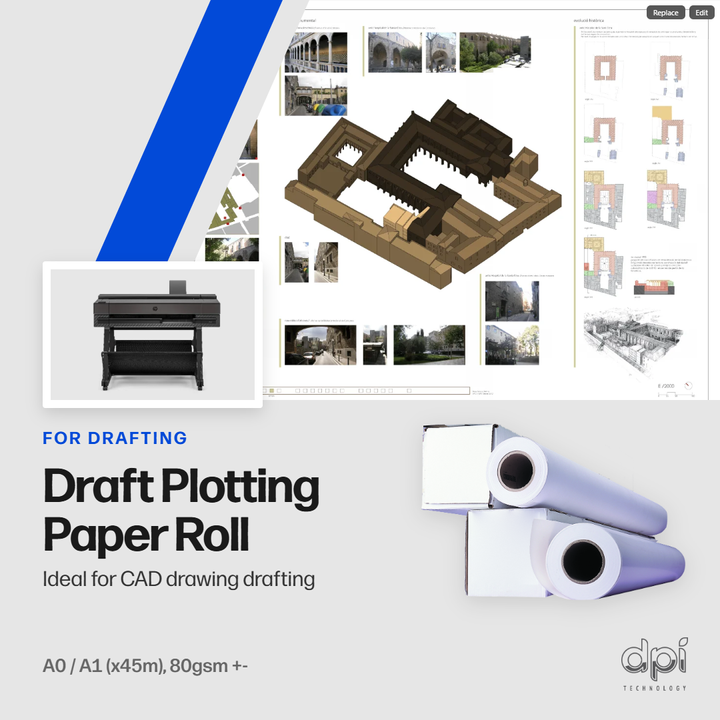
841 mm × 45.72 m rolls; about 38 A0 or 76 A1 drawings per roll.
- Regular price
- RM 140.00
- Sale price
- RM 140.00
- Regular price
-
RM 0.00
-
Plain paper · 80 gsm · Box of 4
A1 Plotting Paper Roll
594 mm × 45.72 m rolls for CAD line drawings; about 53 A1 prints per roll.
- Regular price
- RM 104.00
- Sale price
- RM 104.00
- Regular price
-
RM 0.00
-
Linen · 110 gsm (±)
A0 Linen Paper Roll
841 mm × 25 m linen roll for submissions and archive sets; about 20 A0 per roll.
- Regular price
- RM 375.00
- Sale price
- RM 375.00
- Regular price
-
RM 0.00
-
Linen · 110 gsm (±)
A1 Linen Paper Roll
Tear-resistant 594 mm × 10 m roll for authority submissions and archive sets.
- Regular price
- RM 148.00
- Sale price
- RM 148.00
- Regular price
-
RM 0.00
-
Linen · 50 sheets
A1 Linen Paper Sheets
A pack of 50 A1 linen sheets for a few submission drawings without loading a roll.
- Regular price
- RM 478.00
- Sale price
- RM 478.00
- Regular price
-
RM 0.00
-
Coated · 120 gsm
24" Coated Inkjet Paper
Brighter colour for drawings, renders and posters: 610 mm × 35 m, about 41 A1 per roll.
- Regular price
- RM 125.00
- Sale price
- RM 125.00
- Regular price
-
RM 0.00
-
Coated · 120 gsm
36" Coated Inkjet Paper
914 mm × 35 m roll for colour drawings and posters; about 29 A0 or 58 A1.
- Regular price
- RM 187.00
- Sale price
- RM 187.00
- Regular price
-
RM 0.00
-
Photo · Glossy
24" Glossy Photo Paper
Shiny photo finish for presentation renders and posters: 610 mm × 30 m roll.
- Regular price
- RM 350.00
- Sale price
- RM 350.00
- Regular price
-
RM 0.00
-
Photo · Glossy
36" Glossy Photo Paper
914 mm × 30 m glossy roll for renders, photos and posters; about 25 A0.
- Regular price
- RM 380.00
- Sale price
- RM 380.00
- Regular price
-
RM 0.00
-
Photo · Semi-gloss
24" Semi-Gloss Photo Paper
Semi-gloss photo finish for renders and posters: 610 mm × 30 m roll.
- Regular price
- RM 390.00
- Sale price
- RM 390.00
- Regular price
-
RM 0.00


Essential for AEC Industries
What Are Plotter Paper Rolls?
Continuous rolls of specially formulated paper designed for wide-format printers. Engineered to fit HP DesignJet, Canon imagePROGRAF, and Epson SureColor spindles perfectly.
Precision and consistency are paramount. Our paper ensures exceptional line quality and dimensional accuracy for authority submissions to DBKL, JKR, and PWD.
Paper Types & Features
Standard uncoated paper for everyday CAD drawings and line work. Smooth surface ensures razor-sharp lines for architectural plans.
Translucent paper for overlays and tracing. Durable surface ideal for creating multiple design iterations and visual overlays.
High-gloss coated paper for vibrant presentations. Delivers exceptional image quality for renderings and marketing materials.
Premium textured paper for official archives. Mandated by PWD and JKR for permanent government record keeping.
Handle by the core, avoid touching the printable surface. Load rolls carefully to prevent jams. Proper handling ensures print quality.
Store in a cool, dry place (20-25°C). Protect from direct sunlight and humidity to prevent yellowing and maintain quality.
Technical Specifications
Use 80 gsm plotting paper for everyday CAD drawings and check prints; our A0 and A1 rolls are 45.72 m long, four rolls to a box. Use 110 gsm (±) linen paper for authority submissions and archive sets, because it resists tearing and keeps well in storage. For colour plans and presentations, 120 gsm coated inkjet paper gives brighter colour.
Yes, for most CAD plotters. Our rolls have a standard 2-inch core and fit HP DesignJet, Canon imagePROGRAF TM and Epson SureColor T plotters. Check the width: A1 (594 mm) and 24-inch (610 mm) rolls fit 24-inch and wider plotters, while A0 (841 mm) and 36-inch (914 mm) rolls need a 36-inch plotter or wider.
Keep rolls in their wrapping and box until you use them, in a cool, dry room away from sunlight, air-conditioner drips and damp walls. Humidity makes paper curl and cockle, which causes jams and smudged lines. Wrap part-used rolls again after use, and use older stock first. Linen paper keeps especially well, which is why it is used for archive sets.
Professional Applications
Technical plotter paper rolls are essential for diverse professional applications across the AEC industry and beyond.
Industry Use Cases
Rely on technical paper for printing building plans, structural drawings, and site layouts. Bond paper for working drawings, linen paper for final submissions.
Require durable prints for on-site handling. Bond paper withstands handling while maintaining dimensional accuracy critical for construction coordination.
Use glossy photo paper for high-quality posters and exhibition banners. Superior color reproduction makes it ideal for marketing materials.
Paper Choice Guide
Learn about the different types of plotter paper and which one is best suited for your technical printing needs.
Additional Resources
Access specifications, compatibility charts, and storage guidelines. Learn about ISO standards and government requirements.
Discover best practices for selection, handling, and storage. Prevent paper jams, poor print quality, and premature yellowing.
Get expert tips on choosing the right paper, optimizing settings, and troubleshooting issues. Contact support for guidance.